Microneedling and derma rollers for hair loss: what the trials show
In randomised trials of pattern hair loss, adding microneedling to minoxidil increased hair counts more than minoxidil alone; a 2025 meta-analysis pooled hair-count data from 10 trials with 587 people. A derma roller used without minoxidil has much less evidence, and the trial that started the interest used weekly sessions on a cleaned scalp that stopped at mild redness. Sources: [1]; [2]; [3].
Prepared by Seoul Hair Loss editors. Published · Updated
Watch scalp microneedling in 22 seconds
A cleaned scalp patch, a roller with fine needles passed over the thinning area in three directions, tiny punctures in the skin between the hair follicles, and the session ending when the skin turns mildly pink.
Transcript
- Scalp microneedling starts with a cleaned, disinfected scalp.
- A roller with fine needles passes over the thinning area lengthwise, up and down, and diagonally.
- The needles make tiny punctures in the skin between the hair follicles.
- The session stops when the skin turns mildly pink.
- Ask your clinician about infection, bleeding and when to pause scalp medicines.
Contents
What is microneedling for hair loss?
Microneedling makes many tiny punctures in the skin with fine needles. The devices range from stamps and hand-held rollers, often sold as derma rollers, to motorised pens, and the treatment is done both at home and in clinics. For hair loss it has mostly been studied as an add-on to minoxidil in androgenetic alopecia, the common pattern type. The proposed mechanism is that the small wounds release growth factors that act on the follicles and help a topical medicine pass into the skin[4].
Does microneedling with minoxidil regrow more hair than minoxidil alone?
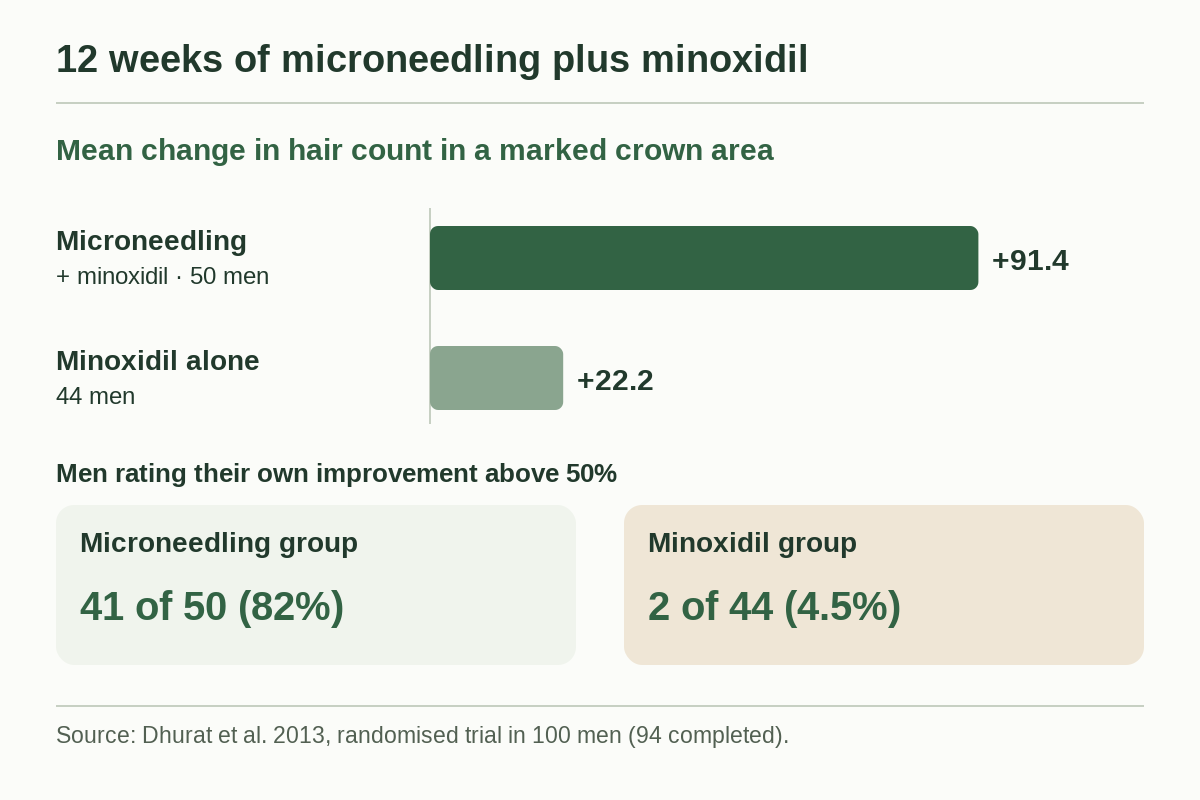
The trial that drew attention to the idea was small. In 2013, 100 men with pattern hair loss were randomly assigned to 5% minoxidil lotion twice a day, with or without one microneedling session a week; 94 completed the 12 weeks. In a marked area on the crown, the hair count rose by an average of 91.4 hairs in the microneedling group and 22.2 in the minoxidil group. Forty-one of the 50 men who had microneedling (82%) rated their improvement above 50%, compared with 2 of the 44 men on minoxidil alone (4.5%)[3].
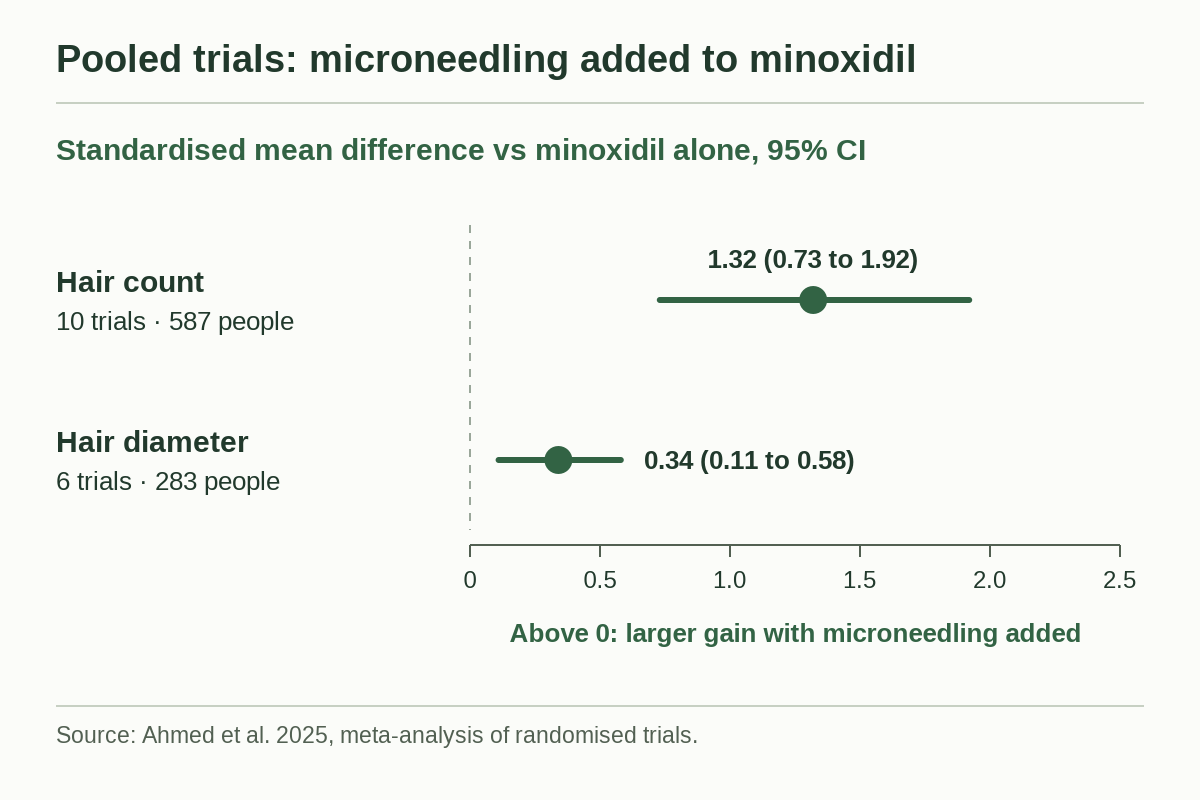
Later trials pointed the same way. A 2025 meta-analysis pooled hair-count results from 10 randomised trials with 587 people and found a standardised mean difference of 1.32 in favour of adding microneedling to minoxidil. The size of the benefit varied a great deal between trials (I² 88%). Six trials with 283 people also measured hair diameter and found a smaller gain, with a standardised mean difference of 0.34[1]. An earlier meta-analysis of eight trials found the same direction for hair count, but its result for hair diameter was not statistically significant[5].
How each session ran in the 2013 trial
Men in the microneedling group had one session a week for 12 weeks, alongside minoxidil lotion twice a day. Sources: [3].
Step 1 of 4: Cleaning the scalp
The scalp was prepared with Betadine and normal saline.
Step 2 of 4: Rolling in three directions
A roller with 1.5 mm needles was passed over the thinning area lengthwise, vertically and diagonally.
Step 3 of 4: Stopping at mild redness
Rolling stopped when mild redness appeared, the end point the trial set for every session.
Step 4 of 4: Minoxidil the next day
Minoxidil was left off on the day of the session and restarted 24 hours afterwards.
Does a derma roller help hair growth without minoxidil?
Far less is known. A 2026 review found only three studies of derma rollers used on their own: one clinical study reported more and thicker hairs, a second found no significant improvement in hair density or scalp coverage, and the third was done in animals. The authors judged the evidence limited and inconsistent[2]. In a 2022 systematic review of 22 clinical studies, 174 people received microneedling alone, and only one small study, in alopecia areata, compared it with an untreated patch of scalp[4].
How deep do microneedling needles go into the scalp?
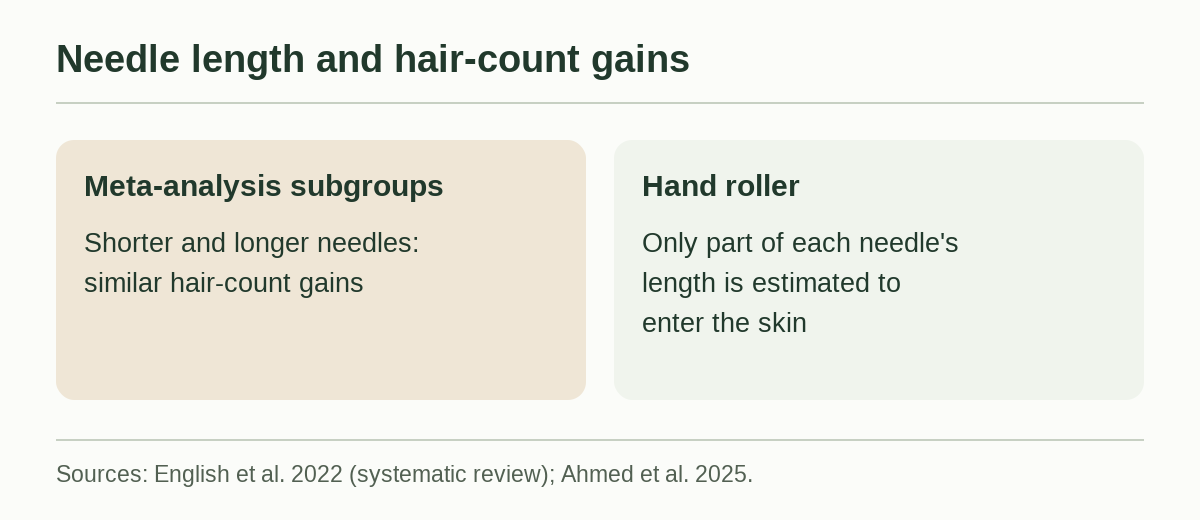
In the 2022 review, the 17 studies of androgenetic alopecia used needles 0.25 to 2.50 mm long, with sessions anywhere from twice a week to once a month, on average every 2.64 weeks; the five studies of alopecia areata and alopecia totalis used needles 1.00 to 5.00 mm long, on average every 3.46 weeks. The androgenetic alopecia studies also stopped each session at different points: a set number of passes, mild redness, or bleeding[4]. Needle length is not the depth reached. One estimate is that a hand roller with 3.00 mm needles reaches only 50–70% of that length into the skin, because of hand pressure and the angle at which the needles enter, and one trial team placed the hair follicle bulge 1.00–1.80 mm below the skin surface[4]. In the 2025 meta-analysis, trials with needles of 1 mm or less and trials with longer needles showed similar gains in hair count[1].
Is rolling at home the same as microneedling in a clinic?
Not quite. In the 2013 trial, sessions were held once a week in a hospital dermatology department, on a cleaned scalp, and stopped at mild redness[3]. The 2026 review of derma rollers noted that hand-operated rollers bring variability in technique and treatment settings, and that improper technique may increase the risk of skin injury and scarring[2].
Two case reports from 2026 describe serious problems after frequent or unsupervised needling. A 28-year-old man had knocked his forehead on a door three months earlier and was treating himself with minoxidil spray followed by a derma roller, without antiseptic precautions. He developed an abscess under the scalp that extended through a defect in the skull bone and needed surgery under general anaesthesia; the authors linked the infection to rolling over inflamed skin and called for supervised use[6]. In another, a 31-year-old man who had used a microneedling device every day for three months developed a basal cell carcinoma, a type of skin cancer, at the front hairline where he had been needling[7].
What side effects did microneedling trials report?
Among 536 people who had microneedling for androgenetic alopecia in the 2022 review, no serious side effects were reported; short-lived pain, scalp irritation and mild redness were the most common[4]. In the 2025 meta-analysis, side effects were more frequent with microneedling plus minoxidil (74 events) than with minoxidil alone (59), and they were generally mild or settled on their own. Enlarged lymph nodes (9 events) and one infection were recorded only in the microneedling groups[1].
Should you add microneedling to minoxidil?
The trials support microneedling as an add-on for pattern hair loss rather than a replacement for medicine: all 17 studies of androgenetic alopecia in the 2022 review tested it alongside other treatments, and 21 of its 22 studies lasted less than a year. Treatment for hair loss depends on its cause, and these studies enrolled people with a diagnosed type, mostly androgenetic alopecia, which is why a diagnosis comes before choosing any scalp procedure. Sources: [4].
Minoxidil, finasteride and the other hair loss medicines are compared in hair loss medicines, and scalp PRP, injections and laser in in-clinic hair loss treatments.
How often was microneedling done in hair loss studies?
In the 17 studies of androgenetic alopecia in a 2022 review, sessions ranged from twice a week to once a month, every 2.64 weeks on average, and treatment lasted 20.01 weeks on average; in the five studies of alopecia areata and alopecia totalis, sessions were every 3.46 weeks on average and treatment lasted 14.20 weeks on average[4]. The 2013 trial used one session a week for 12 weeks[3].
When does new hair show after microneedling?
In the 2013 trial, new hair growth was noticeable at around 6 weeks with microneedling plus minoxidil, and at around 10 weeks with minoxidil alone[3].
Does microneedling help alopecia areata?
The four studies, with 201 people, point different ways. Microneedling changed severity scores more than cryotherapy in one; in another it improved the response to photodynamic therapy but made no difference on its own; steroid injections did better than microneedling alone in a third; and with topical PRP it matched carbon dioxide laser with PRP in the fourth[4].
Is microneedling for hair loss painful?
Short-lived pain was one of the most commonly reported side effects in the studies, along with scalp irritation and mild redness[4].
References (7)
Bibliographic records retrieved from PubMed (U.S. National Library of Medicine).
Microneedling and derma rollers for hair loss: what the trials show
- Ahmed KMA, Kozaa YA, Abuawwad MT, et al. Evaluating the efficacy and safety of combined microneedling therapy versus topical Minoxidil in androgenetic alopecia: a systematic review and meta-analysis. Arch Dermatol Res. 2025;317(1):528. PubMed: 40056230
- Tieu IT, Goldstein DR, Verma KK, et al. Role of dermaroller-mediated microneedling in hair follicle stimulation and hair growth. Dermatol Online J. 2026;32(2). PubMed: 42522488
- Dhurat R, Sukesh M, Avhad G, et al. A randomized evaluator blinded study of effect of microneedling in androgenetic alopecia: a pilot study. Int J Trichology. 2013;5(1):6-11. PubMed: 23960389
What is microneedling for hair loss?
- English RS Jr, Ruiz S, DoAmaral P. Microneedling and Its Use in Hair Loss Disorders: A Systematic Review. Dermatol Ther (Heidelb). 2022;12(1):41-60. PubMed: 34854067
Does microneedling with minoxidil regrow more hair than minoxidil alone?
- Abdi P, Awad C, Anthony MR, et al. Efficacy and safety of combinational therapy using topical minoxidil and microneedling for the treatment of androgenetic alopecia: a systematic review and meta-analysis. Arch Dermatol Res. 2023;315(10):2775-2785. PubMed: 37665358
Is rolling at home the same as microneedling in a clinic?
- Jain R, Sharma A, Bhardwaj P, et al. Subpericranial and epidural abscess with skull osteomyelitis as a complication of microneedling for alopecia: A singular case report. Surg Neurol Int. 2026;17:501. PubMed: 42829587
- Aydemir AT, Erol Mart HM, Akay BN. Basal Cell Carcinoma Arising at the Site of Repeated Microneedling-Induced Microtrauma for Androgenetic Alopecia: A Case Report. Skin Appendage Disord. 2026 Apr 24 (online ahead of print). PubMed: 42327565