Topical finasteride: what trials measured against tablets, and what the FDA’s 2025 alert was about
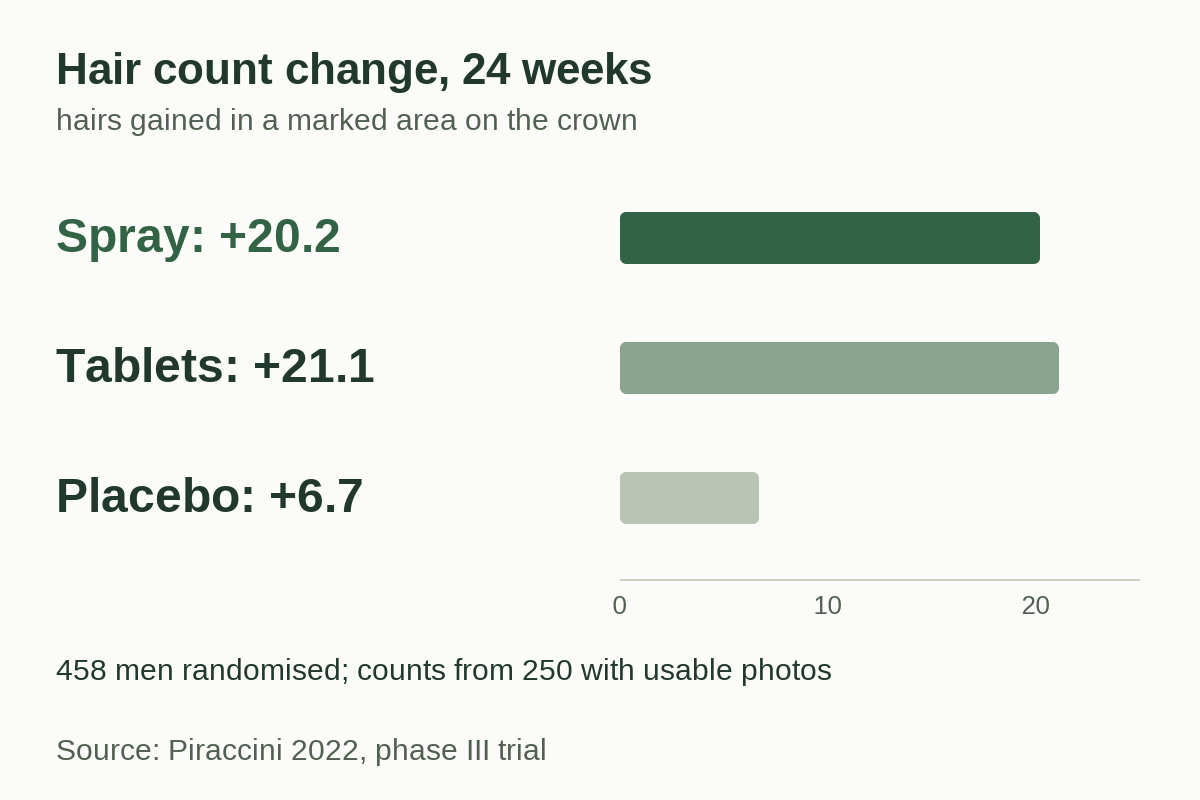
Topical finasteride is finasteride applied to the scalp instead of swallowed. In a 24-week trial that randomised 458 men, a finasteride spray added 20.2 hairs in a marked area, against 21.1 on tablets and 6.7 on placebo, and lowered blood DHT (dihydrotestosterone) by 34.5%, against 55.6% on tablets.[1] An FDA alert dated 22 April 2025 counted 32 adverse event reports for compounded topical finasteride from 2019 to 2024 (FDA alert, checked 12 November 2026).
Prepared by Seoul Hair Loss editors. Published · Updated
Contents
How is topical finasteride different from the tablet?
Men prone to pattern hair loss convert more testosterone into dihydrotestosterone (DHT) inside the hair follicle, through an enzyme called type II 5-alpha-reductase. Finasteride blocks that enzyme.[1]
A liquid applied to the scalp is meant to act on the follicles while less of the drug reaches the rest of the body. The tablet’s own trials are covered in hair loss medicines, and a clinic overview asks whether male-pattern thinning can be prevented at all.
What did the trial against tablets and placebo find?
The phase III trial ran at 45 sites in five European countries from August 2016 to March 2018. It randomised 458 men aged 18 to 40 with mild to moderate thinning on the crown.[1]
Every man used a spray and took a tablet; in each pair one or neither contained finasteride, so nobody knew who was on what. 189 men were assigned the spray, 85 the tablet and 184 placebo; 323 finished the 24 weeks.
Hairs were counted on close-up photographs of a marked area on the crown. 250 men had usable photographs before and during treatment, and the hair count results come from them.
At 24 weeks the spray group had 20.2 more hairs in that area, the placebo group 6.7 more and the tablet group 21.1 more. The gain over placebo was statistically significant; the authors describe spray and tablet as numerically similar.[1]
Two drug companies, Polichem and Almirall, funded the trial, and seven of its ten named authors were Almirall employees when it was completed.
How much finasteride reached the blood?
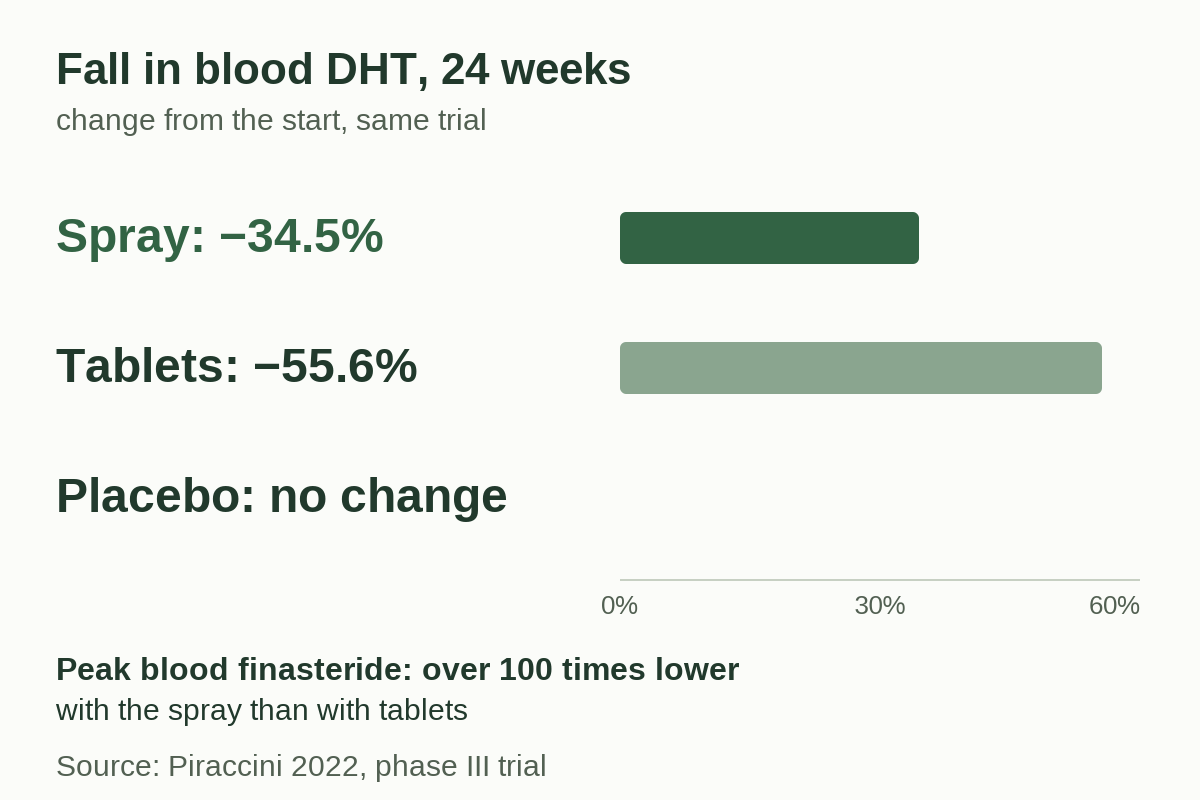
Peak blood levels of finasteride were more than 100 times lower with the spray than with tablets. At 24 weeks, blood DHT was 34.5% lower than at the start on the spray and 55.6% lower on tablets.[1]
In the placebo group, blood DHT stayed level throughout the trial. The spray’s fall in DHT differed significantly from both placebo and tablets at every check from week 4 to week 24.
Which side effects did the trial record?
Adverse events of any kind, related to treatment or not, were reported by 41.4% of men on the spray, 42.0% on placebo and 48.8% on tablets. None of the serious events was judged to be related to treatment.[1]
Treatment-related side effects in the 24-week trial
- Measure
Men assessed for safety
- Finasteride spray
- 181
- Finasteride tablets
- 84
- Placebo
- 181
- Measure
Any treatment-related side effect
- Finasteride spray
- 9.9%
- Finasteride tablets
- 11.9%
- Placebo
- 6.6%
- Measure
Itching
- Finasteride spray
- 2.2%
- Finasteride tablets
- 1.2%
- Placebo
- 0.6%
- Measure
Skin redness
- Finasteride spray
- 2.2%
- Finasteride tablets
- 0%
- Placebo
- 0%
- Measure
Sexual side effects
- Finasteride spray
- 2.8%
- Finasteride tablets
- 4.8%
- Placebo
- 3.3%
- Measure
Stopped because of sexual side effects
- Finasteride spray
- 0%
- Finasteride tablets
- 2.4%
- Placebo
- 1.1%
On a sexual function questionnaire, scores did not differ significantly between spray and placebo at week 12 or week 24.[1]
What have studies since the trial reported?
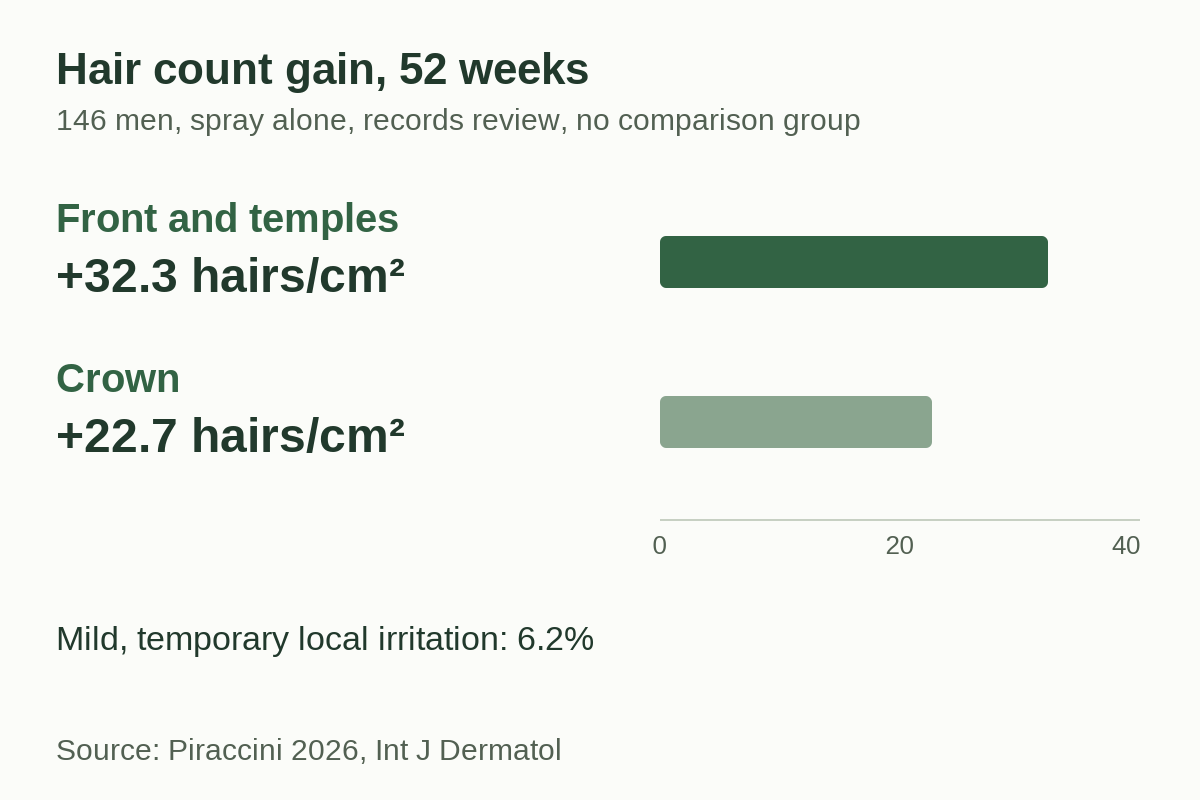
A 2026 retrospective study from clinics in Italy and Switzerland reviewed 146 men, average age 31, who used a finasteride spray alone for 52 weeks. Men with past sexual or mood problems or breast enlargement were excluded.[2]
Hair counts rose by 22.7 hairs per cm² on the crown and 32.3 at the front and temples, and 6.2% had mild, temporary local irritation. The study had no comparison group.[2]
A second retrospective study looked back at 26 postmenopausal women with female pattern hair loss who used the spray alone for 52 weeks. It also had no comparison group.[3]
In those women, hair density went from 149.48 to 172.84 hairs per cm² and hair thickness from 40.42 to 51.04 µm. No adverse events were recorded.[3]
In a 2025 Canadian consensus, 11 physicians reviewed 45 hair loss treatments and listed topical finasteride among the seven they recommend, with finasteride and dutasteride tablets, topical and oral minoxidil, PRP and microneedling.[4]
What was the FDA’s 2025 alert about?
The FDA alert dated 22 April 2025 concerns compounded topical finasteride, sold by compounders and telemedicine platforms alone or mixed with other ingredients such as minoxidil (FDA alert on compounded topical finasteride, checked 12 November 2026).
It counts 32 cases reported to the FDA Adverse Event Reporting System between 2019 and 2024. They describe erectile dysfunction, anxiety, suicidal thoughts, brain fog, depression, fatigue, insomnia, decreased libido and testicular pain (FDA alert, review and discussion).
Most of those reports said the effects continued after the product was stopped. Some patients said a prescriber had told them there was no risk because the product was topical (FDA, April 2025).
The alert adds local reactions (irritation, redness, dryness or scaling, stinging and burning) and a greater chance of exposing other people, specifically women, through transfer of the applied product (FDA alert).
It explains that finasteride has the potential to cause abnormalities in a male fetus. A coating on finasteride tablets prevents contact during normal handling unless they are broken or crushed; compounded topical products have no coating (FDA).
What should you ask before starting a finasteride spray?
- Is the product compounded, and what else is in it? The FDA alert is about compounded products, with finasteride alone or mixed with ingredients such as minoxidil (FDA alert background).
- Who else could touch the product or the treated scalp? The alert names transfer to others, specifically women, and asks prescribers to explain the risks of handling (FDA recommendations).
- If it also contains minoxidil, what does early shedding mean? Timing and when to call are covered in minoxidil shedding.
- Where do you report a side effect? The FDA asks patients, prescribers and compounders to report adverse events with compounded products to its MedWatch program (FDA reporting note).
Does topical finasteride work as well as the tablet?
In the phase III trial that included both, the spray added 20.2 hairs in a marked area at 24 weeks and tablets 21.1, which the authors describe as numerically similar; placebo added 6.7.[1]
Does topical finasteride cause fewer sexual side effects than the tablet?
In that trial, treatment-related sexual side effects were reported by 2.8% of men on the spray, 4.8% on tablets and 3.3% on placebo, and peak blood finasteride was more than 100 times lower with the spray.[1]
What did the FDA warn about topical finasteride?
An alert dated 22 April 2025 counted 32 adverse event reports for compounded topical finasteride from 2019 to 2024, most saying the effects continued after stopping, and named transfer of the product to others, specifically women (FDA alert).
References (4)
Bibliographic records retrieved from PubMed (U.S. National Library of Medicine).
Topical finasteride: what trials measured against tablets, and what the FDA’s 2025 alert was about
- Piraccini BM, Blume-Peytavi U, Scarci F, et al. Efficacy and safety of topical finasteride spray solution for male androgenetic alopecia: a phase III, randomized, controlled clinical trial. J Eur Acad Dermatol Venereol. 2022;36(2):286-294. PubMed: 34634163
What have studies since the trial reported?
- Piraccini BM, Rapparini L, Quadrelli F, et al. Effectiveness and Safety of Topical Finasteride for Male Androgenetic Alopecia: Real World Data. Int J Dermatol. 2026;65(10):2102-2107. PubMed: 41874081
- Piraccini BM, Gupta AK, Cedirian S, et al. Topical Finasteride 0.25% Solution for Female Pattern Hair Loss (FPHL) in Postmenopausal Women: A 52-Week Retrospective Observational Study. Int J Dermatol. 2026 Oct 15 (online ahead of print). PubMed: 42876360
- Landells I, Chow E, Gupta AK, et al. A Canadian Consensus on Androgenetic Alopecia: Approach and Management. J Cutan Med Surg. 2025;29(5 suppl):5S-14S. PubMed: 40986632