Minoxidil shedding: when it starts, how long it lasts and when to call a doctor
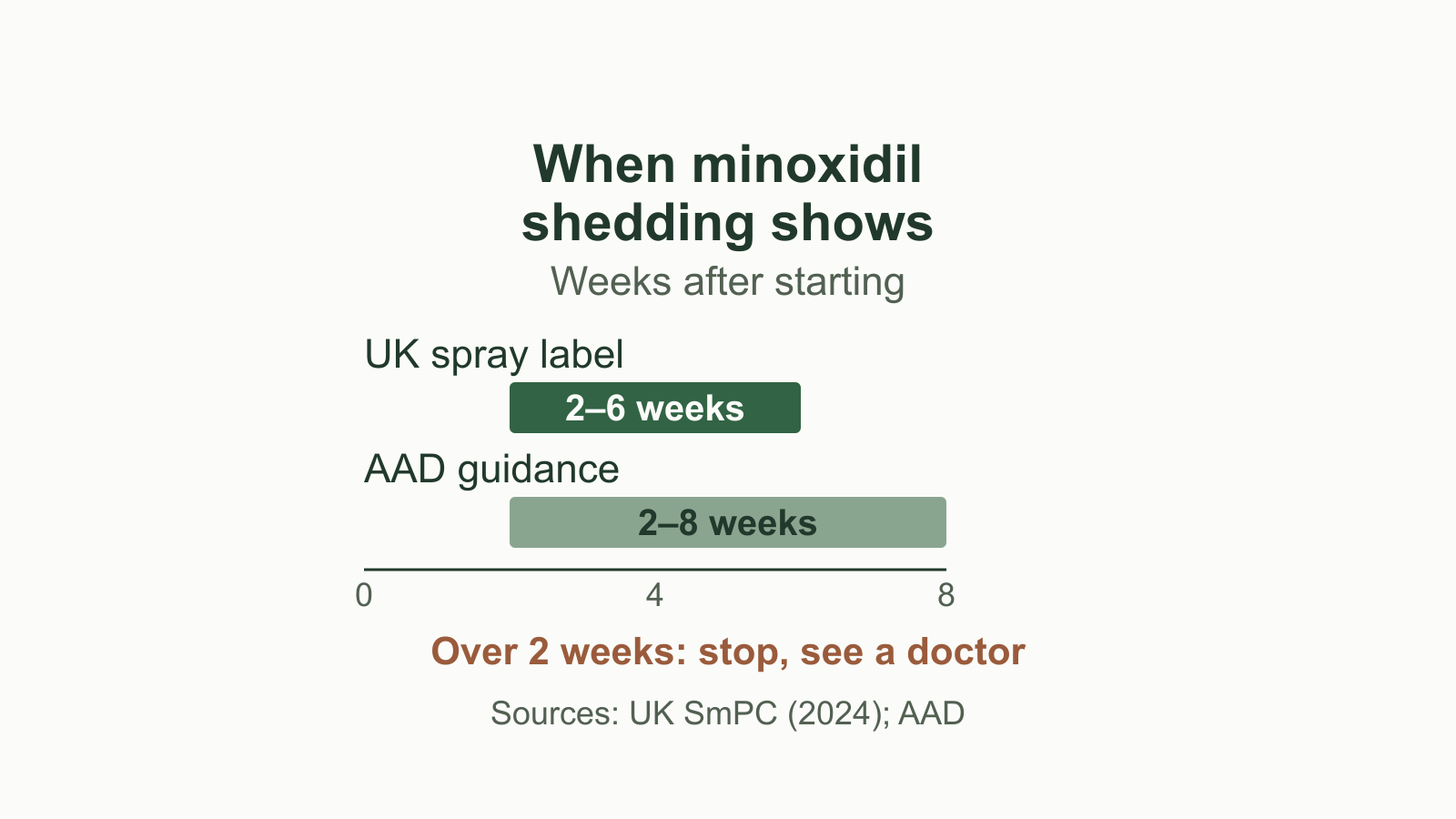
Extra shedding in the first weeks of minoxidil is a recognised, temporary effect. The UK product information for a 5% spray places it two to six weeks after starting, says it regresses within a few weeks, and tells users to stop and see a doctor if it lasts more than two weeks (UK SmPC, revised October 2024, checked 1 November 2026); the American Academy of Dermatology describes the first two to eight weeks (AAD, checked 1 November 2026). With low-dose minoxidil tablets, a 2026 review puts temporary shedding at 16 to 22%.[1]
Prepared by Seoul Hair Loss editors. Published · Updated
Contents
Why does minoxidil make hair shed at first?
Every follicle cycles between a growing phase (anagen) and a resting phase (telogen), after which the resting hair falls out. The UK product information explains the early shed this way: minoxidil shortens the resting phase, so follicles reach the growing phase sooner, and the new hairs push out the old resting ones. The shed comes with increased regrowth and can be read as a first sign that minoxidil is acting (UK SmPC section 4.4). The hair cycle itself is explained in types of hair loss.
When does minoxidil shedding start, and how long does it last?
The sources give different windows, and none gives one number for everyone. The UK product information for a 5% spray says shedding has been seen two to six weeks after starting and regresses within a few weeks (UK SmPC). The American Academy of Dermatology says that for the first two to eight weeks there may be a temporary increase in hair loss, which stops when hair begins to regrow (AAD female pattern hair loss page).
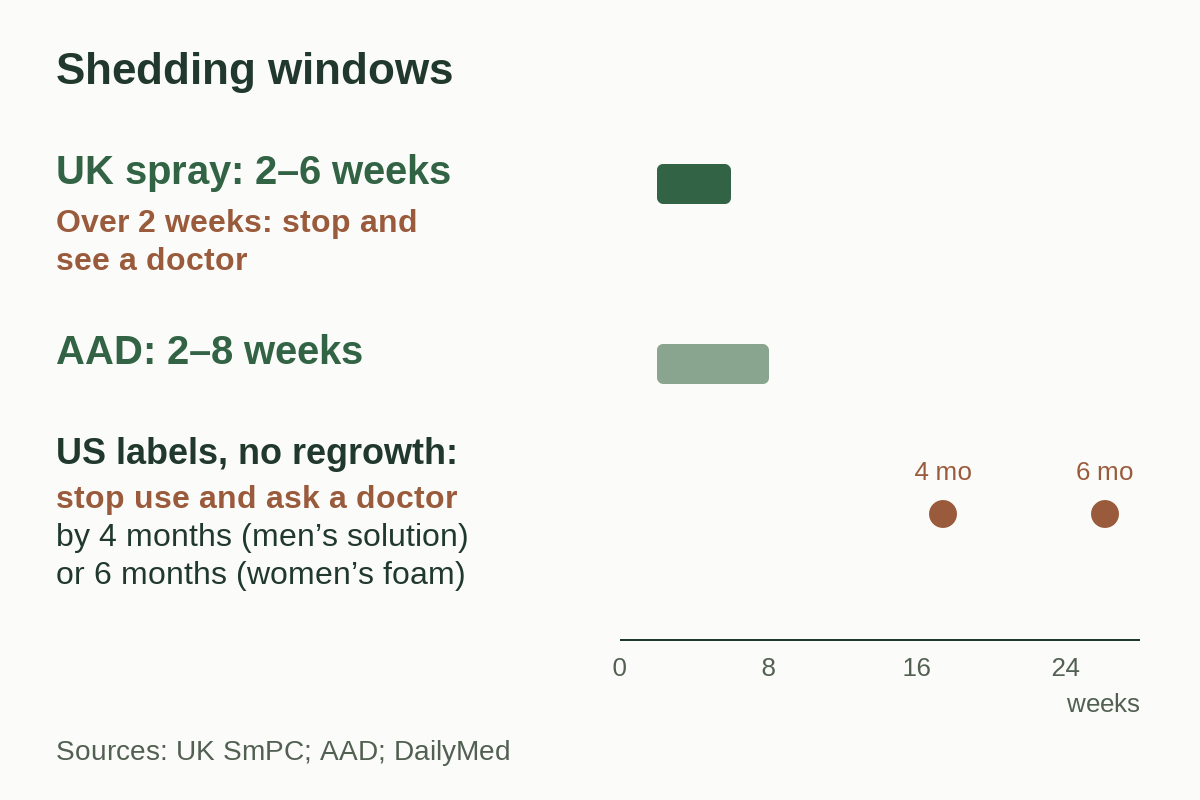
The US Drug Facts labels on Rogaine products set out the slower timeline of regrowth rather than shedding. The men’s 5% solution says results may appear at 2 months, that some men need at least 4 months, and to stop use and ask a doctor if there is no hair regrowth in 4 months (DailyMed, label effective September 2024); the women’s foam gives the same instruction at 6 months (DailyMed, label effective November 2024). The American Academy of Dermatology puts the time needed to judge minoxidil at about six to 12 months of continuous use (AAD).
How often is shedding reported with minoxidil tablets?
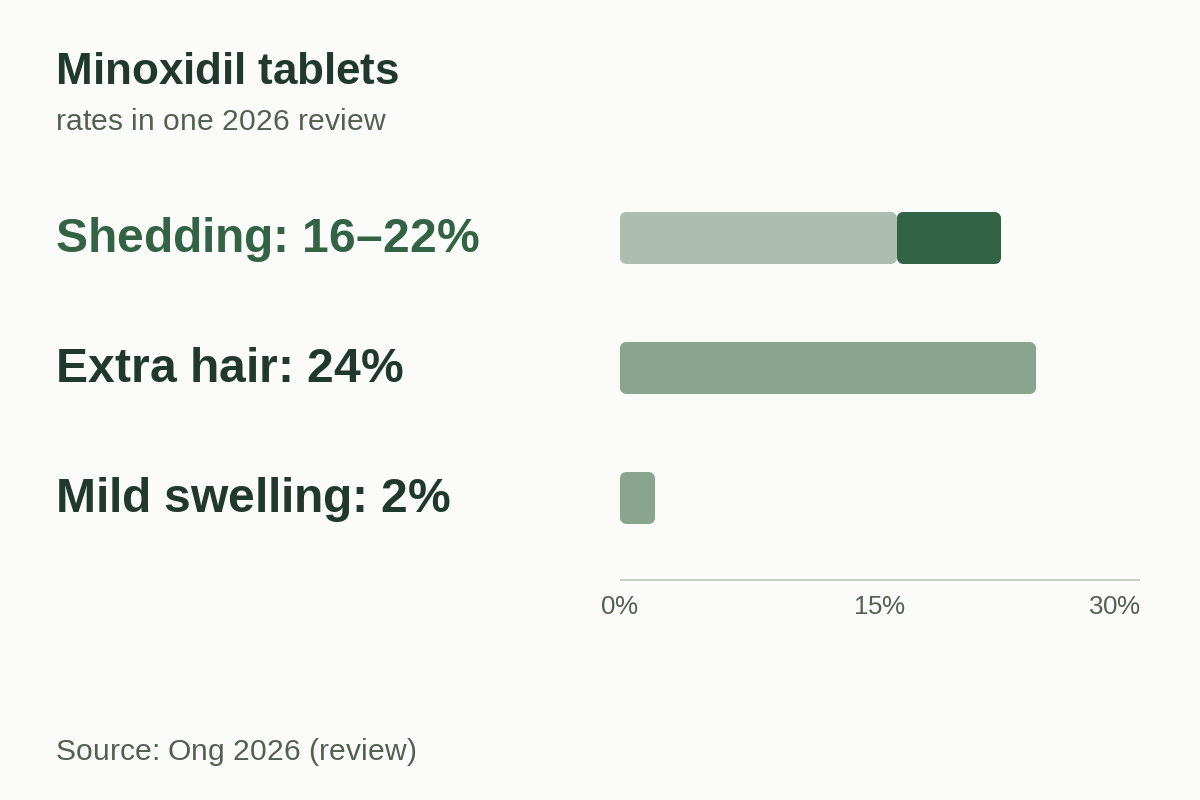
Low-dose minoxidil tablets are used off-label for hair loss. A 2026 review of the tablets puts temporary shedding at 16 to 22%, extra hair growth on the face or body at 24% and mild peripheral swelling (oedema) at 2%, with serious complications such as fluid around the heart rare at the doses used for hair loss.[1] For the spray, the UK product information lists temporary hair loss with a frequency that cannot be estimated from the available data (UK SmPC section 4.8). The other side effects of the tablets are covered in oral minoxidil side effects.
Should you stop minoxidil while you are shedding?
The product information answers this for the UK spray: if shedding persists beyond two weeks, stop using it and consult a doctor, and using more than recommended or more often does not improve results (UK SmPC). The American Academy of Dermatology adds that minoxidil works only while it is used: stopping it loses its benefits (AAD). For tablets, any change is a decision for the prescriber.
Shedding that does not fit the pattern needs a different explanation. The US women’s foam label tells people not to use it if their hair loss is sudden or patchy, follows childbirth or has no known cause (women’s foam Drug Facts), and it helps to know the difference between ordinary shedding and hair loss that keeps progressing before blaming the medicine.
When do the labels say to stop and ask a doctor?
- Shedding that lasts more than two weeks on the UK spray: stop using it and consult a doctor (UK SmPC).
- Chest pain, a rapid heartbeat, faintness or dizziness, sudden unexplained weight gain, or swollen hands or feet: stop use and ask a doctor (men’s Drug Facts; women’s Drug Facts).
- Scalp irritation or redness, or unwanted facial hair growth: stop use and ask a doctor (men’s label; women’s label).
- No hair regrowth in 4 months on the men’s 5% solution (men’s 5% label) or in 6 months on the women’s foam (women’s foam label): stop use and ask a doctor.
How long does minoxidil shedding last?
Is minoxidil shedding a good sign?
The UK product information describes it as resting hairs being pushed out by new growth, accompanied by increased regrowth, and says it can be read as a first sign that minoxidil is acting (UK SmPC section 4.4).
How common is shedding on minoxidil tablets?
A 2026 review of low-dose oral minoxidil puts temporary shedding at 16 to 22%, alongside extra body hair at 24%.[1]
References (1)
Bibliographic records retrieved from PubMed (U.S. National Library of Medicine).
Minoxidil shedding: when it starts, how long it lasts and when to call a doctor
- Ong MM, Li Y, Lipner SR. Oral Minoxidil for Alopecia Treatment: Risks, Benefits, and Recommendations. Am J Clin Dermatol. 2026;27(1):101-119. PubMed: 41118052